Client: Dr. Reza RahbarGhazi’s group
Field: Cancer biology / tumor microenvironment
Figure type: Origin and effect illustration
Published: Cell Communication and Signaling (2024), Tumorigenic and tumoricidal properties of exosomes in cancers; a forward look (figure 2)
Delivered: High-resolution PNG and editable Adobe Illustrator file
The brief
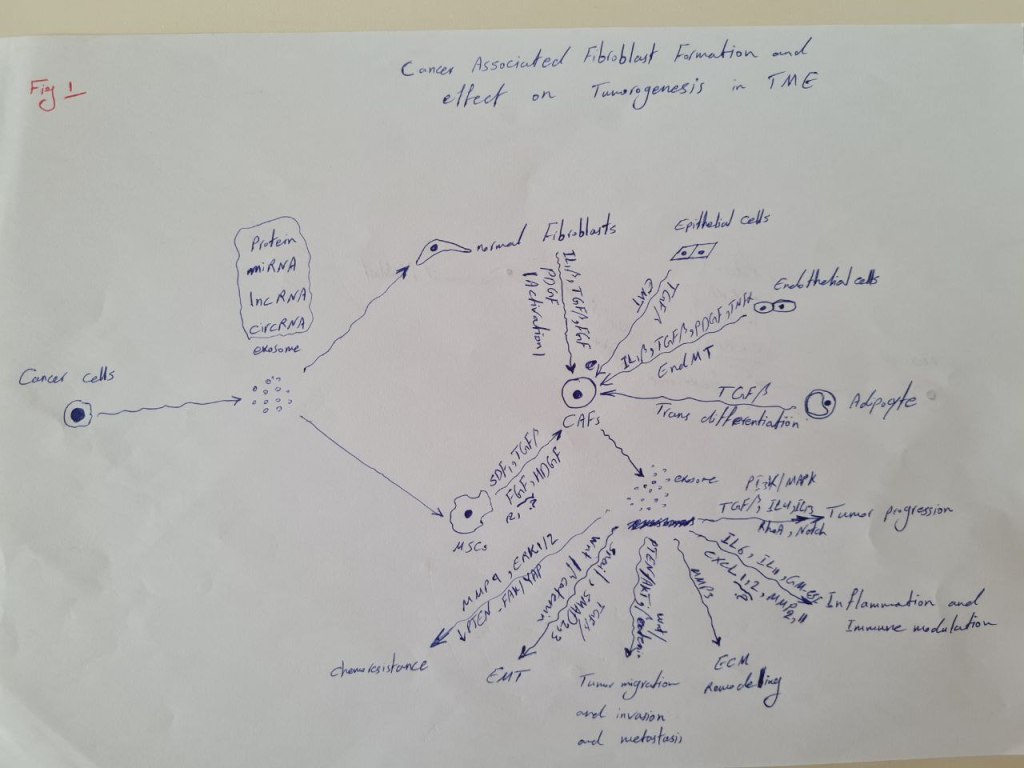
The second figure in this exosome review focused on cancer-associated fibroblasts (CAFs), one of the most influential cell types in the tumor microenvironment. It needed to answer two questions: where do CAFs come from, and what do their exosomes do to the tumor?
The challenge
CAFs have at least five possible origins, each driven by different signals, and their exosomes act through six separate outcomes. Drawn as one network, the inputs and outputs would cross over each other.
My approach
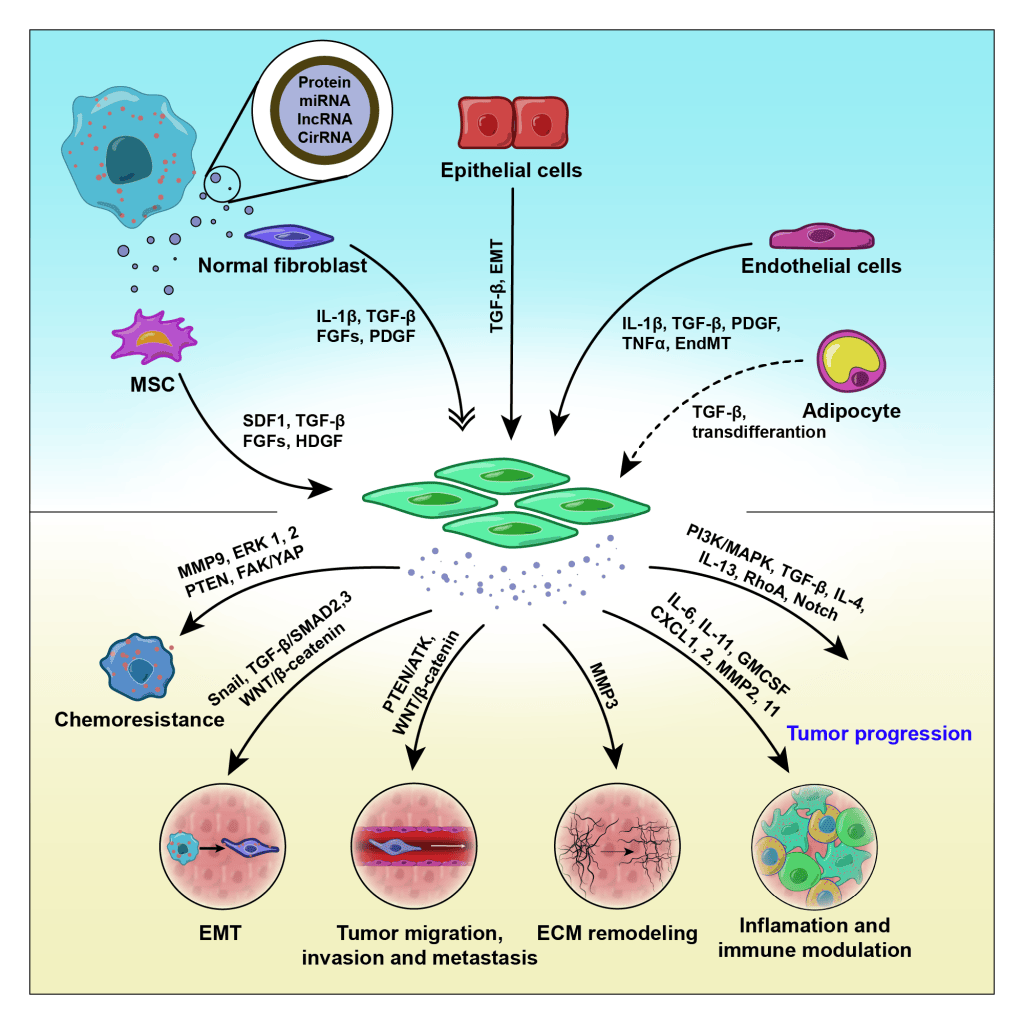
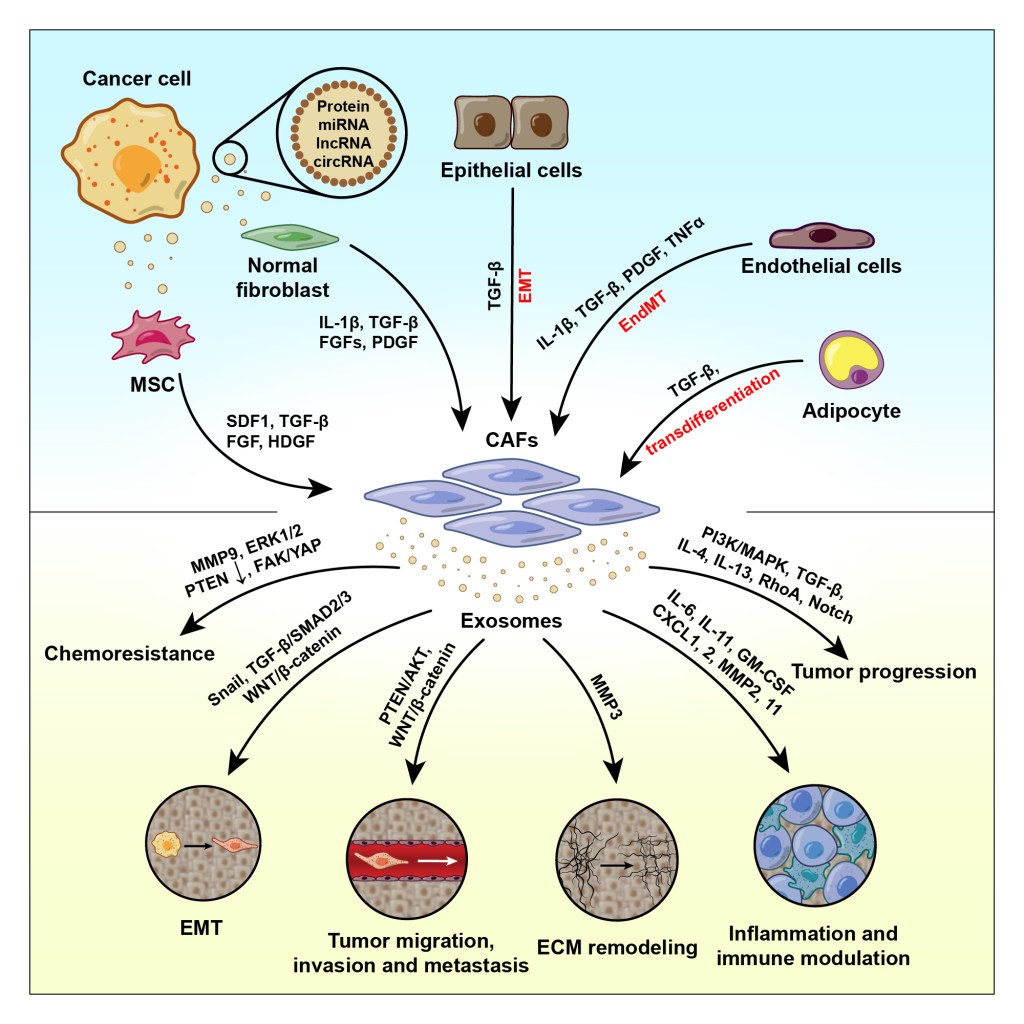
Two halves, two questions: the background splits into a blue top half for origins and a yellow bottom half for effects, with the CAF cluster sitting on the line between them.
Top, origins: normal fibroblasts, epithelial cells (through EMT), endothelial cells (through EndMT), adipocytes (through transdifferentiation), and MSCs all point into the CAF cluster. Each arrow carries the signals that drive the change, and the transition names are highlighted in red.
Bottom, effects: CAF exosomes spread out in six directions: chemoresistance, EMT, migration and metastasis, ECM remodeling, inflammation, and tumor progression. Four of these end in small circular “tissue windows” that show the effect itself, such as a cell squeezing into a vessel.
The result
A figure that reads cleanly in both directions, inputs above and outputs below, with the CAFs as the hinge between them. The tissue-window circles became a recurring device across the paper’s other figures.
Need a figure for the tumor microenvironment? Start a project →